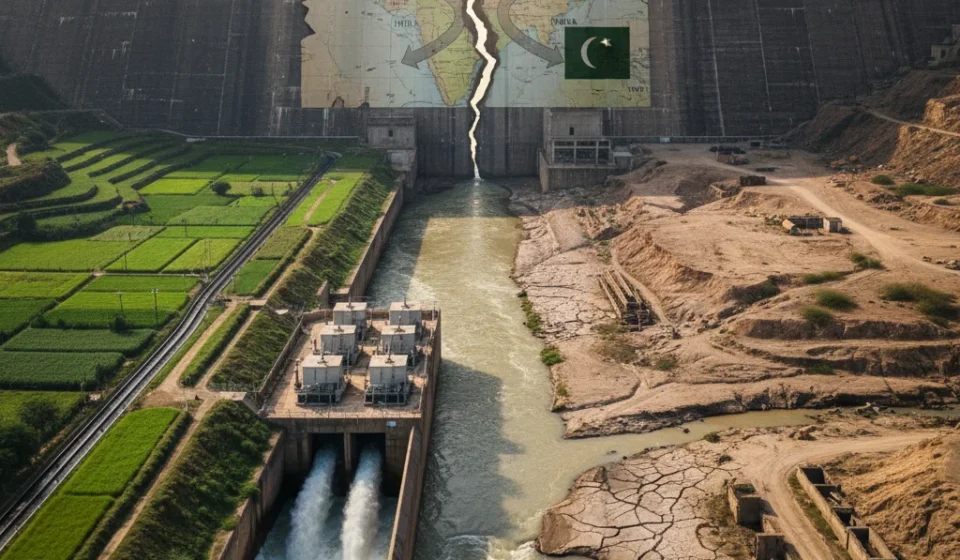

A Legal Rift in Vienna and The Hague
Two separate international panels are currently examining the exact same river engineering blueprints, yet they are doing so under completely different legal assumptions. At the heart of the standoff are two Indian hydroelectric installations in Jammu and Kashmir: the operational 330-megawatt Kishanganga plant and the 850-megawatt Ratle facility under construction on the Chenab River.
Pakistan contends that both run-of-the-river projects violate design parameters established under the 1960 Indus Waters Treaty. India insists they strictly adhere to the accord’s technical annexures. What began as a dispute over dam crests, pondage, and low-level orifice spillways has spiraled into an unprecedented institutional crisis, pulling the World Bank, the Permanent Court of Arbitration, and an independent neutral technical team into an unresolved clash of jurisdictions.
The Dual-Track Precedent
The Indus Waters Treaty, signed in Karachi by Indian Prime Minister Jawaharlal Nehru and Pakistani President Mohammad Ayub Khan after nine years of negotiations, has survived three wars. It allocates the eastern rivers—the Sutlej, Beas, and Ravi—to India, while giving Pakistan rights over the western rivers—the Indus, Jhelum, and Chenab. India retains permitted non-consumptive uses on the western rivers, including run-of-the-river hydropower generation, provided specific design constraints in Annexure D are met.
Trouble mounted in 2015 when Pakistan raised technical objections to Kishanganga and Ratle. Initially, Islamabad requested the appointment of a Neutral Expert. Months later, Pakistan withdrew that request and demanded a Court of Arbitration instead. India countered by insisting that the differences were strictly technical engineering matters, which, under Article IX of the treaty, must go to a Neutral Expert before any judicial court can be convened.
Caught in the middle, the World Bank paused both processes in 2016 to encourage a negotiated settlement. When years of bilateral talks yielded nothing, the Bank lifted the pause in late 2022. It appointed Michel Lino as the Neutral Expert and named Sean Murphy as chairman of a seven-member Court of Arbitration. The decision created two parallel tracks covering the exact same dispute.
India’s Boycott and the Question of Jurisdiction
India reacted to the dual appointment by drawing a hard line. New Delhi welcomed the Neutral Expert mechanism and sent high-level delegations led by its senior water officials to procedural meetings and technical hearings in Vienna. However, India declared the Court of Arbitration in The Hague illegal, refusing to appoint arbitrators or attend its hearings.
The Indian stance relies on the treaty’s graded dispute resolution framework. Under Article IX, issues are first classified as “questions” for the Permanent Indus Commission. If unresolved, they become “differences” reserved for a Neutral Expert. Only if the Neutral Expert decides an issue constitutes a broader legal dispute or falls outside technical competence can it move to a Court of Arbitration. By jumping straight to a court, New Delhi argues, Pakistan bypassed the mandatory treaty hierarchy.
The Court of Arbitration rejected India’s jurisdictional objections. In a unanimous ruling on competence, the court stated that it possessed the authority to consider the matter and would proceed despite India’s absence. The tribunal emphasized that the World Bank had acted within its administrative powers and that non-appearance by one party does not halt proceedings.
Engineers vs. Arbitrators: The Technical Sticking Points
Behind the procedural friction lie complex calculations of water velocity, silt accumulation, and reservoir storage.
- Kishanganga: Located near Bandipora, this project diverts water from the Kishanganga River (known as the Neelum in Pakistan) into the Jhelum basin via an underground tunnel. Pakistan argues the diversion reduces downstream flows vital for its own Neelum-Jhelum Hydroelectric Project and agricultural lands in Pakistan-administered Kashmir. India maintains the treaty expressly permits basin diversions once minimum environmental flows are delivered.
- Ratle: Situated on the Chenab in Kishtwar district, Ratle has drawn Pakistani objections over pondage capacity, the elevation of intake gates, and the sizing of low-level spillways. Islamabad worries that deep orifice spillways give India the physical capacity to manipulate river flows, either by holding back water during critical planting seasons or releasing surges downstream. Indian engineers maintain that deep sluices are essential to flush out heavy Himalayan sediment and prevent turbines from choking.
The simultaneous proceedings create a real danger of conflicting outcomes. If Michel Lino determines in Vienna that Ratle’s spillway gates satisfy Annexure D, while the Court of Arbitration in The Hague rules that identical gates breach the treaty, neither state will have a clear legal path forward. The 1960 text offers no mechanism to resolve a conflict between a Neutral Expert’s determination and an arbitral award.
Notice to Modify the Treaty
Frustrated by what it describes as Pakistan’s procedural intransigence and the creation of parallel bodies, India took a historic step. New Delhi served formal notice to Islamabad under Article XII(3) of the pact, demanding government-to-government negotiations to amend the treaty.
Indian officials argue the treaty must be modernized to reflect realities that did not exist six decades ago. Fundamental changes in demographic pressure, urgent clean energy targets, changing agricultural water usage, and the accelerating impact of Himalayan glacier retreat have shifted the baseline assumptions of the 1960 agreement. India wants a streamlined dispute mechanism that prevents parallel forums and ensures cross-border river governance can handle clean power development without years of litigation.
Pakistan has approached the modification request cautiously, wary that reopening the text could dilute its water security guarantees. With hearings continuing in both European cities and technical data piling up on both sides, the Kishanganga and Ratle cases have become the ultimate test of whether the world’s most enduring transboundary water pact can adapt to twentieth-first-century pressures or fracture under the weight of its own dispute machinery.