Federal cyber forensic specialists and intelligence officials across India have broadened their inquiry into a surge of coordinated bomb threats aimed at international commercial flights, with a sharp focus on Gulf-bound Air India Express operations.
Over the past several weeks, false alarms dispatched through social media accounts triggered massive security sweeps, grounded international flights, and forced several mid-air diversions. The pattern shows clear coordination. Investigators now believe multiple digital actors used automated scripts, virtual private networks (VPNs), and disposable profiles on social media platform X to spread terror warnings simultaneously.
A Web of Anonymous Threats
The operational disruptions began escalating when anonymous accounts started tagging airline handles and airport security units in quick succession. Many of the messages cited specific flight numbers operating between southern Indian hubs—including Kochi, Kozhikode, Mangaluru, and Tiruchirappalli—and key destinations across the Middle East such as Dubai, Sharjah, Muscat, and Dammam.
Air India Express operates a dense network of short-haul international flights catering to millions of Indian expatriates working across the Gulf Cooperation Council (GCC) countries. Because these routes maintain tight turnaround schedules, even a single delayed flight creates cascading disruptions across the carrier’s entire timetable.
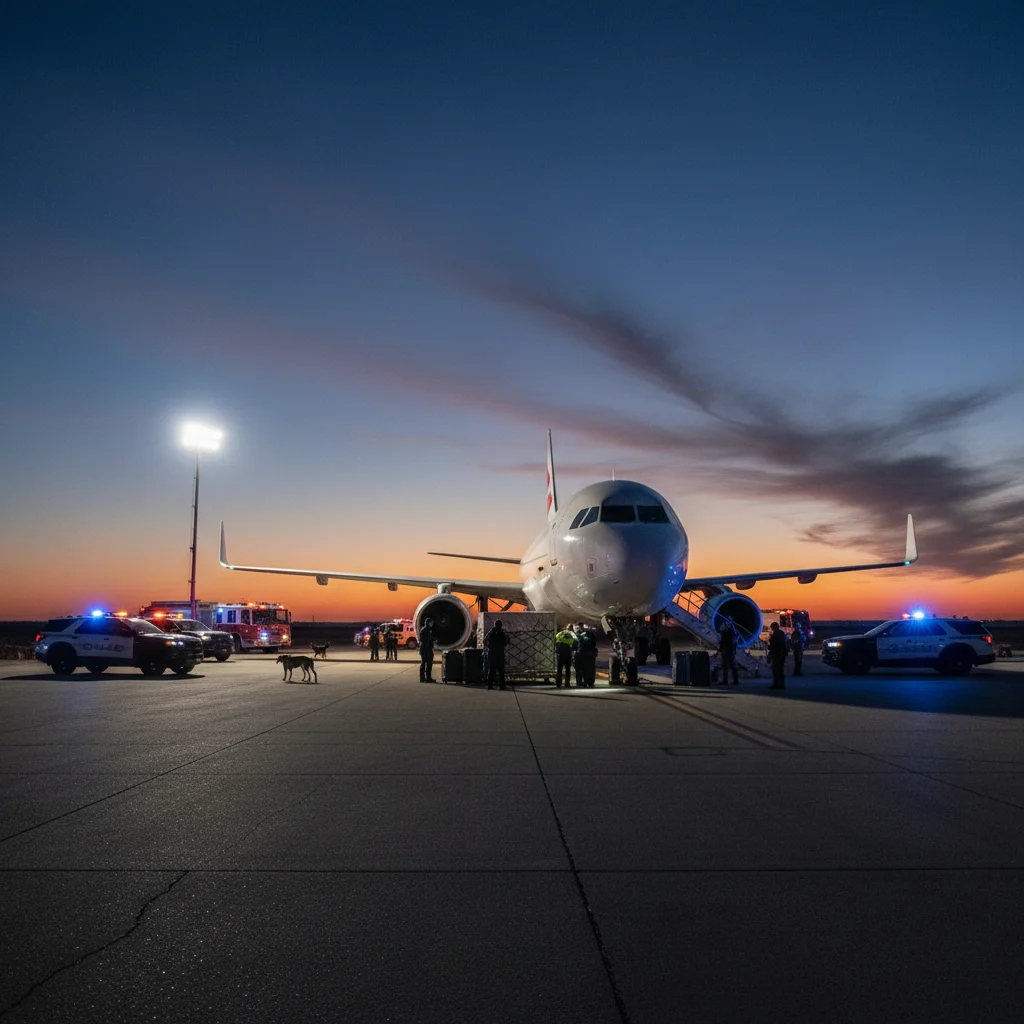
When a threat arrives, aviation protocols leave zero room for assumption. Each alert triggers an immediate assembly of the Bomb Threat Assessment Committee (BTAC) at the relevant airport. If deemed ‘specific,’ the aircraft must divert to the nearest suitable airfield or move immediately to an isolated bay. Passengers are evacuated via stairs, while security forces, sniffer dogs, and explosive disposal units inspect every piece of checked baggage, cargo pallet, and cabin crevice.
Tracing the Digital Footprint
Cyber crime divisions in Delhi, Mumbai, and Bengaluru are working closely with the Indian Computer Emergency Response Team (CERT-In) to trace the origin of the accounts. Preliminary analysis shows that the perpetrators routed their web traffic through multi-layered proxies and encrypted virtual networks based in Europe, North America, and parts of Southeast Asia.
Investigators have reached out to social media platforms and international internet service providers, seeking user metadata, registration IP addresses, and device fingerprints. Legal requests under Mutual Legal Assistance Treaties (MLAT) and notifications through Interpol channels have been drafted to expedite access to logs held on overseas servers.
Investigative teams are currently focusing on several key vectors:
- The identification of bot networks used to blast identical threat templates to multiple carriers within seconds.
- The extraction of unmasked IP addresses where VPN handshakes failed or leaked transient connection data.
- Digital forensic recovery of dark-web forum posts where threat templates may have been shared or commissioned.
- Cross-referencing timing patterns to verify whether threats originated from domestic perpetrators using foreign proxies or overseas entities.
A senior official tracking the investigation noted that while unmasking users behind obfuscated networks takes time, the sheer volume of posts generated by the perpetrators increases the likelihood of an operational security slip. Every connection leaves a trace somewhere along the routing chain.
The Staggering Cost of Disruption
While every single threat inspected so far has turned out to be a hoax, the real-world fallout has been severe. Diverting a fully loaded Boeing 737 or Airbus A320 requires burning or dumping excess fuel to reach a safe landing weight. Airlines must then pay for unscheduled ground handling, aircraft re-fueling, passenger accommodation, and alternative routing.
The financial toll per diverted flight can easily run into millions of rupees. For low-cost carriers operating on razor-thin margins, persistent hoaxes represent a major operational and economic headache. Flight crews also reach their legally mandated duty-time limits during extended ground searches, requiring airlines to fly in relief pilots and cabin crew to resume journeys.
Beyond the airlines, central security personnel from the Central Industrial Security Force (CISF) and local police forces have spent hundreds of man-hours screening thousands of pieces of luggage, creating bottlenecks during peak travel hours.
Legal Tightening and Deterrent Measures
The wave of hoaxes has drawn urgent attention from the Ministry of Civil Aviation and the Bureau of Civil Aviation Security (BCAS). Policymakers are actively drafting legislative amendments to significantly toughen penalties for individuals issuing false security alerts.
Proposed measures include placing convicted hoaxers on a mandatory no-fly list for extended periods, classifying malicious threat generation as a cognizable and non-bailable offense under aviation security statutes, and recovering operational damages directly from perpetrators.
Civil aviation authorities have simultaneously refined threat assessment criteria. The objective is to give airport security committees better analytical tools to classify obvious automated spam quickly, without compromising passenger safety or halting flights unnecessarily.
For now, security agencies maintain elevated vigilance across all international departures. Passengers on Gulf-bound services have been advised to account for extra processing time at departure terminals as enhanced physical and electronic screening remains in force.