

For seven years, the golden rule of competitive Fortnite was dead simple: high ground wins games. If you could build faster, edit cleaner, and claim the sky, you controlled the lobby.
Not anymore.
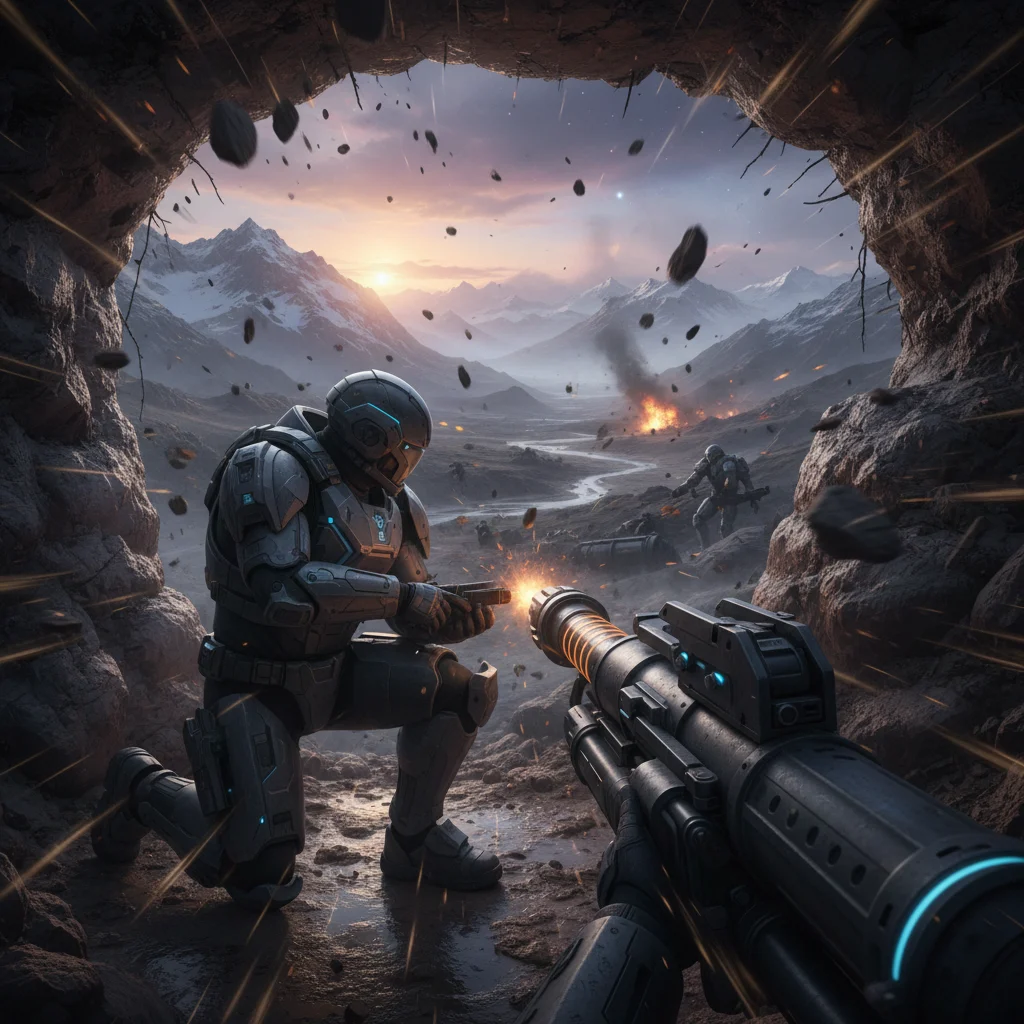
With the launch of Chapter 7, Epic Games introduced procedural terrain deformation. Suddenly, the very earth under players’ feet is no longer static. Heavy explosives, massive kinetic weapons, and vehicles do not just destroy player-built walls anymore. They bite chunks out of the island itself, completely rewriting how the battle royale is played at the highest level.
A Shifting Battlefield
The core of this mechanical shift lies in Epic’s upgraded physics engine. When a heavy projectile like a rocket or the new Cratemaker shell hits a grassy hill, it leaves a permanent, four-meter-deep crater. Dirt and rocks scatter, changing the elevation of the local area.
More importantly, any structures built on top of that ground lose their anchoring. If the soil beneath a brick tower gets blasted away, the tower collapses under its own weight. This has turned classic base-building on its head. High-ground players can no longer sit comfortably in towering metal fortresses; a few well-placed explosive rounds can literally liquefy their foundations, bringing the entire setup crashing down.
The Death of the Endgame Tarp
For professional players, the most frustrating adjustment is how this impacts “tarping.” During the final circles of a tournament match, dozens of players crowd into tiny spaces, building tunnels out of wood and metal to rotate safely. It is a high-stress, high-speed ritual.
Now, those tunnels are incredibly vulnerable. Smart teams are no longer shooting at the tunnels themselves. Instead, they target the hillsides holding them up.
“You used to feel safe inside a brick box as long as you were connected to a mountain,” says veteran competitive analyst Marcus “Borealis” Vance. “But now? If an opponent blows up the cliffside your tunnel is anchored to, your entire rotation slides down the hill into the storm. It has made static defense almost impossible in the late game. You have to keep moving, and you have to keep looking down.”
The Rise of Trench Warfare
In response to these crumbling cliffs, some pros are abandoning the high ground altogether. They are turning to what the community is calling “trench warfare.”
By using heavy-duty tools like the Earthbreaker Hammer, duos are deliberately carving deep trenches into the soil during the mid-game. These natural depressions offer excellent protection from sniper fire and cannot be demolished by enemy utility items.
This low-ground strategy has shifted loadout priorities. Traditional assault rifles are frequently being swapped out for terrain-altering tools. Teams are prioritizing items that can dig quick trenches or trigger localized landslides to flush out opponents hiding below them.
Bugs, Balance, and Backlash
As with any massive change, the competitive scene has experienced significant growing pains. The main issue is building consistency. Fortnite’s building grid relies on flat surfaces, and the newly jagged, cratered earth is causing placement errors.
During a recent warm-up tournament, top-tier professional Peter “Peterbot” Wilk was eliminated when a critical wall refused to place on highly deformed terrain.
“You try to drop a wall to block a shot, but the ground is so uneven from a previous explosion that the game thinks there is no flat surface,” Wilk explained during a post-match stream. “The build just doesn’t place. You end up dying because the game decided a hill has too many bumps now. It is incredibly frustrating in high-stakes lobbies.”
Epic Games has already responded to the outcry. A recent hotfix quietly adjusted the “snapping tolerance” for builds on deformed ground, allowing walls to sink deeper into craters to prevent empty gaps. However, the developer has made it clear that terrain deformation is here to stay. Competitors will simply have to adapt to the new, unstable world order.