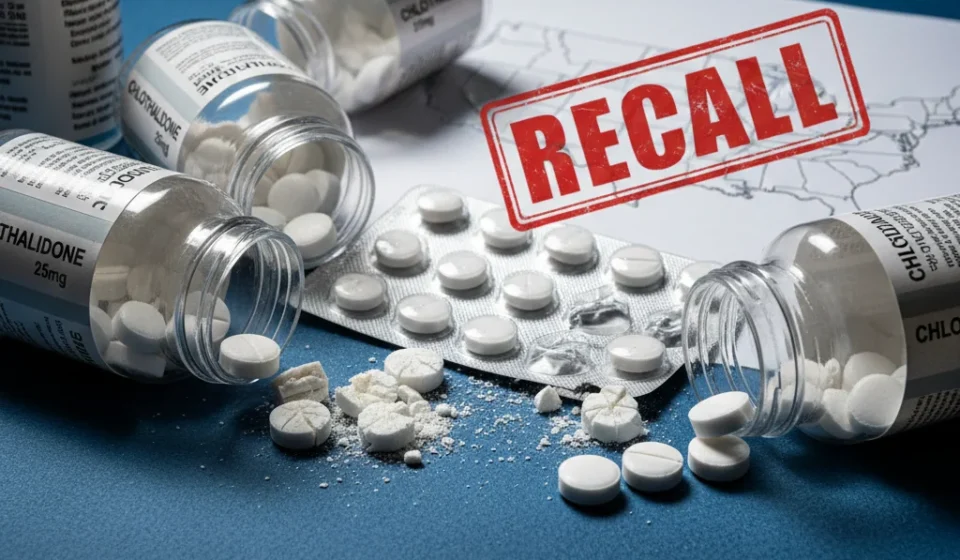

Marlex Pharmaceuticals has launched a nationwide recall of its Chlorthalidone tablets. The voluntary move comes after federal regulators discovered the pills failed to meet dissolution testing standards, a defect that could prevent the drug from working correctly in patients.
The U.S. Food and Drug Administration (FDA) flagged the issue during an audit of the manufacturer’s quality control data. Tests showed that the tablets did not dissolve within the strict time limits required by federal standards. When a pill fails this test, it means the drug may not break down properly in the digestive tract. This prevents the active ingredient from fully absorbing into the bloodstream.
For patients relying on the medication to manage their heart health, the stakes are high.
Understanding the Risks of Failed Dissolution
Chlorthalidone is a widely prescribed generic diuretic, often called a water pill. Doctors routinely prescribe it to treat high blood pressure and to help reduce fluid buildup caused by conditions like heart failure, kidney disease, or cirrhosis.
By helping the kidneys eliminate excess salt and water, the drug reduces the workload on the heart. If the drug does not dissolve, it cannot do its job.
When a blood pressure medication does not dissolve properly, the patient is essentially getting a lower dose than prescribed, or perhaps no medicine at all. The danger here is silent. High blood pressure usually has no symptoms, so patients will not feel that their medication is failing until their numbers spike to dangerous levels.
Uncontrolled hypertension can lead to severe cardiovascular emergencies, including strokes, heart attacks, and permanent kidney damage.
Best CPA Marketing Course – Nogor Web Bangladesh
Identifying the Recalled Medication
The nationwide recall affects both the 25 mg and 50 mg strengths of Chlorthalidone tablets distributed across the country. Marlex packaged the medication in bottles of 30 and 90 tablets.
The recall targets specific batches. Pharmacists and patients should check their prescription bottles for the following details:
- Chlorthalidone 25 mg: Look for bottles with NDC 10135-0182-90 or NDC 10135-0182-30. Affected lots begin with numbers 22 or 23, carrying expiration dates between June 2025 and December 2025.
- Chlorthalidone 50 mg: Look for NDC 10135-0183-90. Affected lots end with the letters A or B, with expiration dates stretching into early 2026.
So far, Marlex Pharmaceuticals has not received any reports of patients suffering adverse medical events related to this recall. However, the company is urging distributors and pharmacies to stop selling the affected lots immediately.
What Patients Should Do Next
If your medication is on the recall list, do not stop taking it immediately. Cardiologists warn that stopping blood pressure drugs cold turkey can cause a rapid, dangerous spike in blood pressure. This reaction, known as rebound hypertension, can pose a more immediate threat than a poorly dissolving pill.
Instead, take these steps:- Contact your pharmacy to see if your specific prescription came from an affected lot.
- Call your doctor’s office to secure a replacement prescription for an alternative batch or a different manufacturer.
- Keep taking your current medication until you have the replacement in hand.
Marlex is contacting its wholesale distributors directly to coordinate the return and destruction of all recalled products. Consumers can contact Marlex customer service at 1-800-555-0199 or email the company’s quality assurance team at recall@marlexpharma.com to arrange returns or ask questions.
The Safety Net of Generic Manufacturing
The vast majority of prescriptions filled in the United States—over 90%—are generic medications. Because generics are far cheaper than brand-name drugs, they are vital for keeping healthcare accessible. However, they must perform identically to the original brand-name drugs.
To ensure this, the FDA requires strict bioequivalence and dissolution testing. Dissolution testing simulates how a pill breaks down in the human stomach. This ensures the drug is released at the correct speed. When audits find issues, the recall system is triggered to protect patients before injuries occur. This incident underscores why regular, independent regulatory checks remain essential for public safety.