
A New Era for Handheld Gaming
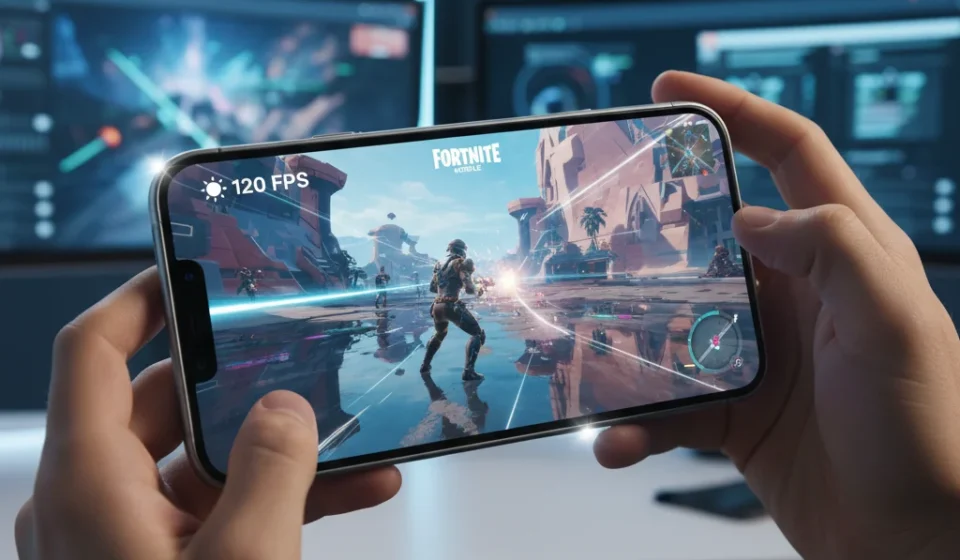
Mobile gaming just took a massive leap forward. If you pick up the new iPhone 18 Pro and boot up Fortnite, you might forget you are holding a phone. For years, mobile players had to make a tough choice. Do you want high frame rates, or do you want the game to look beautiful? You simply could not have both. Epic Games just shattered that compromise. Thanks to Apple’s new A20 silicon, Fortnite’s latest season now runs at a locked 120 frames per second with full hardware-accelerated ray tracing enabled.
The Raw Power of the A20 Chip
It is a technical milestone that seemed impossible on a handheld device just a couple of years ago. The magic lies inside the core of the iPhone 18 Pro. Apple’s A20 chip is built on a cutting-edge 2-nanometer process. This architecture allows for more transistors, higher efficiency, and a massively upgraded GPU. Crucially, the A20 features dedicated hardware ray-tracing cores that are twice as fast as those found in previous models.
Before this hardware upgrade, ray tracing on mobile was mostly a battery-draining gimmick. It would drop frames the moment the action got intense. Now, the silicon handles the heavy lifting easily. The A20’s neural engine also plays a vital role, using smart upscaling to keep resolutions high without heating up the device.
How Epic Games Rebuilt the Engine
But raw hardware power is only half the battle. The software has to be optimized to take advantage of it. Epic Games spent months rebuilding parts of Unreal Engine 5’s mobile renderer specifically for this silicon.
‘We did not just flip a switch,’ says Thomas Vance, a senior graphics programmer at Epic. ‘We had to rethink how Fortnite handles lighting on mobile screens. The A20 gives us direct access to memory features that let us stream high-fidelity textures almost instantly. It allowed us to bring console-quality global illumination to a device that fits right in your pocket.’

Vance notes that the development team focused heavily on thermal management. Nobody wants a game that runs perfectly for five minutes and then starts lagging because the phone is too hot. By offloading lighting calculations to the A20’s dedicated ray-tracing cores, the main CPU runs much cooler. This keeps the framerate stable even during chaotic, late-game build fights.
The Visual Leap on the Island
So, what does this actually look like in the latest season? The difference is immediate. Drop into the new neon-soaked metropolis on the map, and the visual upgrades stand out right away. Water reflects the surrounding skyscrapers in real time. Gunfire illuminates dark corners with accurate, bouncing light. Shadows stretch and soften naturally as the virtual sun sets over the island.
More importantly, the game feels incredibly responsive. In competitive shooters, frame rate is everything. Playing at 120FPS gives mobile players a serious competitive edge, offering lower input latency and smoother tracking. Doing this while keeping ray-traced reflections active is a massive achievement.
Blurring the Line Between Console and Mobile
This update signals a major shift for the industry. The boundary between home consoles and smartphones is disappearing. Not long ago, mobile ports were heavily watered-down versions of PC games. Today, the iPhone 18 Pro is rivaling the visual fidelity of dedicated home consoles.
Of course, this experience is currently locked behind a premium price tag. The iPhone 18 Pro is an expensive entry point for casual gamers. But as this technology trickles down to standard models in the coming years, high-end mobile gaming will become the norm. For now, Fortnite players with Apple’s latest flagship have a clear glimpse into the future of gaming. It is bright, detailed, and runs at a buttery-smooth 120 frames per second.