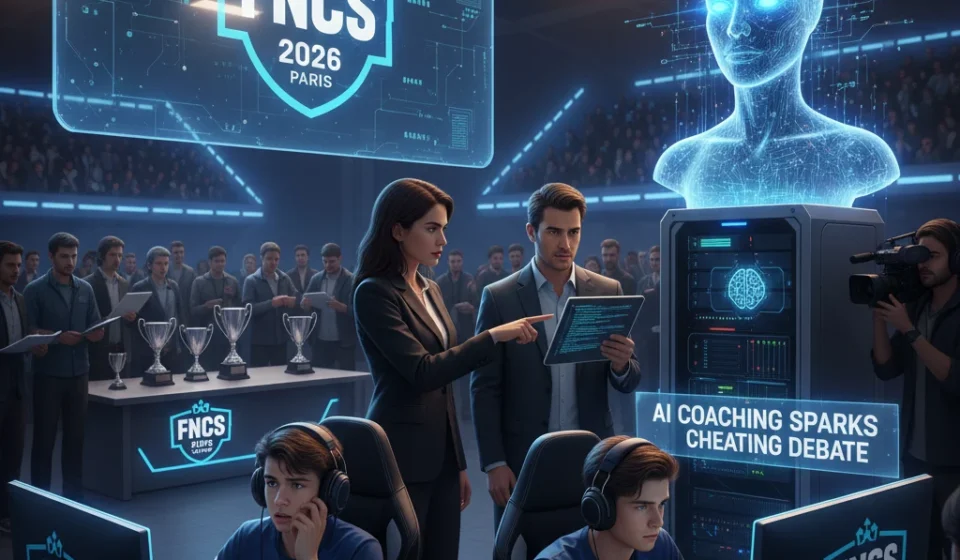

The Fortnite competitive scene is in a state of high anxiety. Just weeks before the world’s elite players head to Paris for the Fortnite Champion Series (FNCS) 2026 Global Championship in October, a massive controversy has erupted. The issue isn’t aimbots or wallhacks this time. Instead, the community is arguing over AI-driven live coaching.
This is not about human coaches anymore. New software can now analyze a player’s live gameplay feed in real-time. It calculates storm rotations, tracks enemy material counts, and whispers optimal tactical decisions straight into a competitor’s headset. The technology is fast, accurate, and completely silent.
Is It Advanced Prep or Flat-Out Cheating?
The core of the debate is whether this technology crosses a line. During online qualifiers, some players have reportedly used these AI tools to gain an edge. The software captures the screen, processes the visual data in milliseconds, and advises the player on where to rotate or when to engage.
While LAN events like the upcoming Paris grand finals offer a controlled environment where players cannot use unauthorized software, the damage may already be done. Many of the coveted spots for the $4 million tournament were secured during online regional qualifiers where monitoring was much harder to enforce.
Epic Games, the developer of Fortnite, is under pressure to clarify the rules before the October event. The company has historically banned third-party software that interacts with the game client, but these AI tools are different. They do not inject code into Fortnite itself. They simply “watch” the screen like a human spectator would.
The Players Divide
The professional community is deeply split on the matter. Some competitors argue that AI coaching is merely the next logical step in the evolution of esports preparation.
“We already have human coaches who sit in Discord during online tournaments, tracking everything and calling out rotations,” said Lucas “Vortex” Miller, a veteran professional player who qualified for the Paris finals. “The AI does the same thing, just a bit faster and without human error. If you aren’t using the best tools available to prepare, you are falling behind.”
https://fortnitevblucksgenerator.vercel.app/

However, others believe this technology ruins the spirit of competition. Competitive analyst Sarah Chen warns that allowing AI assistants threatens to destroy what makes esports exciting.
“A human coach gets nervous. They make mistakes, they miss details, and they cannot instantly calculate how much metal an enemy has left,” Chen said. “An AI does not feel pressure. It turns a game of rapid human decision-making into a sterile exercise of who can follow computer instructions the best. It takes away the magic.”
How Epic Games Plans to Respond
Epic Games is reportedly scrambling to update its tournament regulations ahead of the Paris showcase. Sources close to the competitive division suggest that the publisher will enforce unprecedented hardware lockdowns in France.
Some of the rumored security measures for the FNCS 2026 Global Championship include:
- White-listed communication channels that limit audio inputs strictly to team members.
- A complete ban on personal phones, tablets, or unauthorized devices in both the tournament area and player warm-up lounges.
- Advanced monitoring systems, including eye-tracking cameras, to ensure players are not glancing at secondary screens.
- Strict pre-match checks of all peripheral devices, including headsets and keyboards.
Marcus Vance, a senior esports coordinator at Epic, addressed the community’s concerns in a brief statement. “We are committed to maintaining a fair and competitive environment,” Vance said. “Any tool that automates tactical decision-making during active gameplay goes against the spirit of the Fortnite Champion Series.”
A Defining Moment for Fortnite Esports
Detecting these tools during online play remains an uphill battle. Because the AI software runs on secondary computers or capture cards, standard anti-cheat programs cannot flag them. This leaves the online qualifying phases of future tournaments highly vulnerable.
The October finals in Paris were meant to be a celebration of pure human skill. Now, the event will serve as a crucial test of how esports leagues handle the rapid rise of consumer artificial intelligence. If Epic Games cannot reassure the community that the competition is clean, the shadow of the algorithm may linger long after the champion is crowned.